Being called “sister” as an only child felt so strange. Yet there I was, surrounded by a loving circle of sweet, smiling faces calling me sister. Why was I so determined to come here, alone, at 18? I guess it was a combination of blind confidence and an unyielding desire to feel authentic in my life.
The previous two summers, I had spent almost every weekend doing henna. My mom and I had taken an interest in the art after I got a henna tattoo on my 16th birthday, and we fell in love with the semi-permanent adornment. We bought simple henna kits and hoped we’d be good enough to start a business. We had some natural talent.
We got an LLC and maxed out a credit card for supplies: an outdoor carpet, an EZ-up tent, a few tapestries, plenty of pillows, and a massive order of pure lavender oil and Jamila henna powder, freshly ground from that year’s harvest in Pakistan. You wouldn’t believe the smell.
Late nights with the brown-stained plastic spatula, filling dozens of hand-rolled cellophane cones with warm henna paste fresh from the oven. Sleepy mornings setting up our booth at whatever market or event awaited us. We had the routine down: roll out the carpet, pin up the tapestries, throw the pillows on the ground, wipe the sticky design book pages clean. Ready to be ravaged by all …blissed-out festival-goers, glittery children, bohemian moms, sunburnt dudes spilling beers on our portfolios… (“Y’all do real tats?”)
We had varying degrees of success. My mom relied on it as a source of income, so her mood depended on how much money we brought home after each event. I was 16 and free of bills that first summer, so the money was just fun…enough to treat my friends and me to Frappuccinos or Thai food.
But I was also feeling a growing discomfort that I now know is called Imposter Syndrome. I didn’t deserve the fun, the money, or the endless gushy compliments about my designs… which were really just bad ripoffs of a beautiful and ancient art from a culture not my own. I secretly started dreaming of going to India someday.
I delved into websites, travel shows, and anything I could find about India and its culture. I ordered real Mehndi books from eBay, shipped directly from India. I read them like a novel, studying the patterns and how they fit together. I copied every design by sight, repeating leaf after leaf, swirl after swirl… downloading my new vocabulary into hand and mind.
The following summer, it was on. I knew I needed about $1,800 for a round-trip ticket to India, plus whatever else I could save to live off. The weekends were long, but the joy I felt counting stacks of glittery $5 bills out of my apron pocket was addictive. Rubber-banding stacks of $50 to take to the bank on Monday… fingertips stained brown, smelling of lavender.
Of course, my teenage fantasy of India was quite different from reality. Once those rainbow-sparked dollars turned into a single white paper with a flight route and seat number, it got real. Really real after the goodbyes, when it was just me and the hum of the jet.
On January 16th, 2008, I flew to Trivandrum, at the very southern tip of India in the Tamil Nadu region. I remember the sweet taxi driver Pandi, who offered to make a quick stop so I could check out the Arabian Sea. I was too excited to be aware of any danger and agreed enthusiastically. Twilight bathed the beach, and kids played volleyball in the red sand. Pandi offered to take photos, smiling at everything I said. Later, he would rescue me in the middle of the night from a deviant Dr. Lady who had taken me hostage… but that story is for another day….
By some cosmic lining up of circumstances, I found myself staying at the Avvai Ashram children’s orphanage. I met a girl named Michelle at the airport, a piercer from Arizona volunteering there. She offered me a place to stay, and I gratefully accepted, relieved to have a friend and a safe spot. I was given food and shelter in exchange for helping the kids with English and daily chores.
The Ashram was surrounded by dirt paths, rice paddies, baby peacocks, and the occasional rickshaw from the nearest village. It was remote …no refrigeration, no cell service, no internet. I spent my days braiding coconut oil into girls’ hair, playing games, doing homework, and helping prepare food. They all called me “sister,” and we ate idli with coconut chutney and sambal daily. I daydreamed about cold water.
I spent two months there. Though grateful and truly cherishing my time, homesickness became unbearable. I was on the other side of the world and couldn’t contact my family. I decided to go home halfway through my intended stay … a hard choice. I had come to experience Mehndi firsthand and immerse myself in the art, but instead, I spent eight weeks in an orphanage, exhausted, and not feeling well. I stressed my parents and hadn’t yet found the route to Mehndi mastery I’d naively hoped for.
The night before my flight home, the orphanage arranged a farewell celebration. We dressed in saris, shared a feast, and the kids performed dances. It felt too painful to leave but impossible to stay.
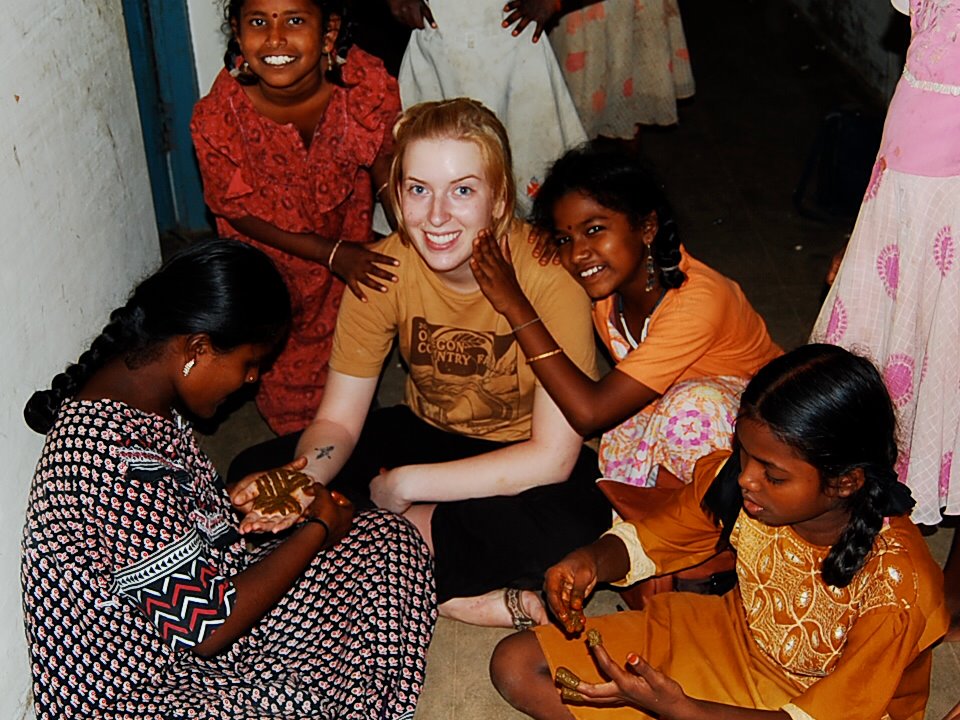
A group of girls ushered Michelle and me to the upstairs sitting area with a big bucket of leaves and water. They started pounding and grinding the leaves by hand …and then it hit me. They were making Mehndi paste. The leaves had come from the bush outside my room; it had been there the whole time. Laughing and joyful, they grabbed our hands, applying simple circles to our palms, sharing happiness in the moment, braiding hair, and singing with joy.
After the food, dancing, and photos, Michelle and I spent the rest of the night talking while I packed. I hadn’t told her I was a henna artist back home, but finally I showed her my portfolio and explained how unbelievable this experience had been.
She was a rockabilly girl with black hair, straight-across bangs, rolled-up jeans, and tons of piercings. Wide-eyed and amazed, she said,
“You should absolutely be a tattoo artist! I work in a shop in Arizona, and it’s seriously the best job ever.”



 Laura Jade